
How to Read DR and DA Correctly in Modern SEO
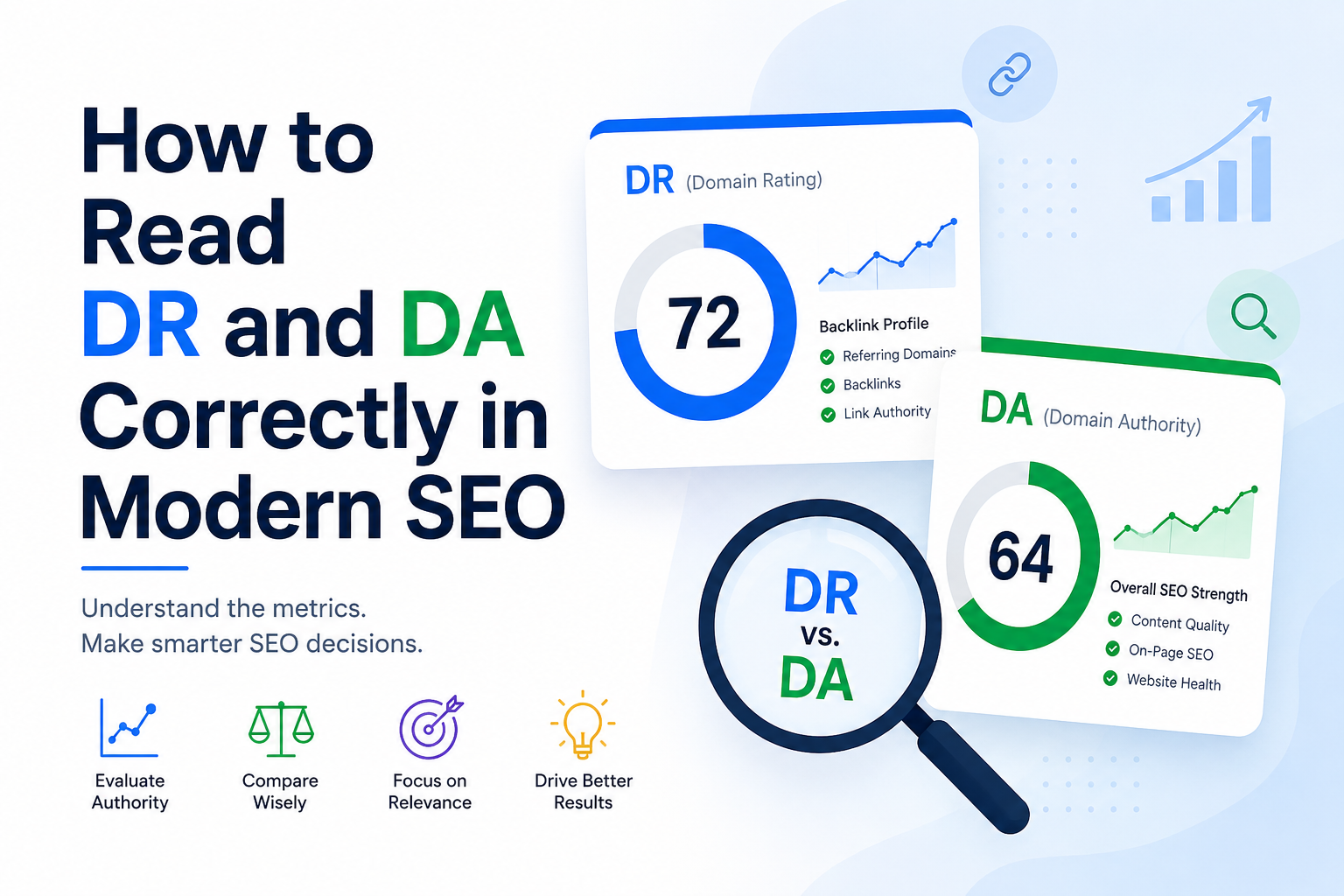
In modern SEO, many people look at DR and DA before anything else. Some use them to judge whether a website is strong, some use them to compare competitors, and others use them when buying backlinks, evaluating guest post opportunities, or choosing outreach targets.
The problem is that many people see DR and DA, but do not really understand them.
If you treat DR and DA like official Google ranking scores, you can make bad decisions very quickly. If you look only at the number and ignore traffic, topical relevance, and page quality, your SEO strategy can easily become distorted.
This article explains how to read DR and DA correctly in modern SEO, what these metrics actually mean, where people misread them, and how to use them without being misled.
What DR and DA Actually Mean
Let’s start with the basics.
DR stands for Domain Rating, which is Ahrefs’ metric for estimating the strength of a website’s backlink profile. It is measured on a 0–100 logarithmic scale. Ahrefs explains that DR is primarily based on the quantity and quality of followed referring domains, as well as how authoritative those linking sites are and how widely they link out to other domains.
DA stands for Domain Authority, which is Moz’s metric. Moz describes DA as a predictive score intended to estimate how likely a domain is to rank in search results compared with other domains. It is also scored on a 0–100 scale, but it is not a Google metric and should not be treated as one.
The simplest way to understand the difference is this:
DR is more focused on backlink strength
DA is more focused on ranking potential prediction
They may look similar on the surface, but they are not measuring exactly the same thing.
Why So Many SEO Professionals Misread DR and DA
The most common mistake is assuming that DR and DA are official Google trust scores.
They are not.
Ahrefs explicitly says DR is a proprietary metric and recommends that users do not rely on it alone to judge the quality or legitimacy of a website. Moz likewise positions DA as a comparative, predictive score rather than a direct search engine signal.
That means:
a high DR does not automatically mean a site ranks well
a high DA does not automatically mean the content is strong
neither metric guarantees SEO value on its own
A domain may have a high DR because it has accumulated many backlinks over time, but it may still have weak content, low organic traffic, or poor topical focus. On the other hand, a site with a lower DR may still perform well because its content is tightly aligned with search intent and its pages are strong individually.
In modern SEO, DR and DA are useful reference points, but they are not answers by themselves.
What a High DR Really Tells You
If you see a site with a high DR, the correct interpretation is:
This domain has a relatively strong backlink profile.
That usually means it has attracted a meaningful number of followed referring domains, and some of those linking domains are strong themselves. Ahrefs notes that DR is influenced by how many unique websites link to a domain, how authoritative those linking domains are, and how many other websites those domains also link to.
But you should not automatically conclude that:
the site has great content
the site gets strong organic traffic
every page on the site is powerful
the site is automatically a good backlink target
This matters because DR is a domain-level metric, not a page-level one. A strong website overall does not mean the specific page where you might get a link is valuable.
That is why experienced SEOs do not stop at the homepage-level score. They also look at the actual page that will host the link.
What a High DA Really Tells You
If you see a site with a high DA, the correct interpretation is slightly different.
It means Moz’s model believes the domain has relatively strong ranking potential compared with other sites. Moz explains that DA is best used as a comparative metric, not an absolute measure of quality.
In practice, DA can be helpful for:
broad competitor comparison
estimating relative domain strength
spotting general trends over time
But just like DR, it should not be used as a standalone decision-making tool.
Why DR 30 to 40 Is Not the Same as DR 70 to 80
This is another area where people misunderstand the metric.
Ahrefs states that DR uses a logarithmic scale, which means it gets progressively harder to increase as the score rises. In other words, going from DR 20 to 30 is much easier than going from DR 70 to 80.
This is important when you are reporting growth or benchmarking websites. A gain of 5 points is not equally meaningful at every stage.
So when you look at DR movement, always look at the context, not just the number itself.
In Modern SEO, You Should Never Read DR or DA in Isolation
If you really want to read DR and DA correctly, you need to combine them with other signals.
Organic traffic
A site with a high DR but almost no meaningful organic traffic may have a strong backlink profile, but limited real search visibility.
Topical relevance
A highly relevant website with moderate authority can often be more valuable than a high-scoring site in a completely unrelated niche.
Referring domain quality
Not all backlinks are equal. It matters where the links are coming from, how relevant those sources are, and whether the site’s link profile looks natural.
Ranking keywords
If a domain has strong DR or DA but does not rank for meaningful terms, that should raise questions about its real SEO value.
Actual page quality
If you are acquiring a link, the quality of the exact page matters. Is it indexed? Does it have internal links? Does it receive traffic? Is the content useful? Domain-level metrics do not answer those questions.
Ahrefs itself recommends looking beyond DR and considering other signals such as domain-level search traffic or page-level strength.
When DR Is More Useful Than DA
If your work is heavily focused on link building, DR is often more useful in day-to-day decisions.
That is because DR is directly built around backlink profile strength. It is commonly used as a quick filtering metric for:
guest post opportunities
outreach targets
digital PR prospects
niche edit opportunities
partnership websites
Ahrefs also notes that DR can be used as a rough proxy when evaluating the strength of a link prospect, as long as it is not the only thing you look at.
So DR is especially useful when the question is:
How strong is this domain’s backlink profile overall?
When DA Can Still Be Useful
DA can still be helpful when your focus is broader website comparison rather than pure link analysis.
Because DA is designed as a predictive ranking metric, it can be useful for:
comparing competitors at a high level
tracking relative authority over time
adding context to an SEO report
estimating how a domain compares in a broader SERP landscape
But again, it is still a third-party model, not a search engine truth score.
How to Read DR and DA Correctly in Modern SEO
The right question is not:
What is this website’s DR or DA?
The better question is:
What do this website’s DR and DA mean when combined with its traffic, relevance, content quality, and page-level value?
That shift matters.
Because modern SEO is no longer about chasing authority scores for their own sake. What matters more is:
whether the page can actually rank
whether the site is topically relevant
whether the link is placed in useful content
whether the site has real visibility and trust
whether the link can support your long-term SEO goals
A DR 70 website with weak relevance and thin content may be less useful than a DR 40 website with strong traffic, clear topical alignment, and trustworthy editorial content.
That is how experienced SEO professionals think about authority metrics today.
Final Thoughts
DR and DA are both widely used in SEO, and both can be valuable when interpreted correctly.
You can think of them like this:
DR = a stronger indication of backlink profile strength
DA = a broader estimate of ranking potential
But neither one is a Google ranking factor, and neither one should be trusted in isolation.