
Best SEO Tools for 2026: What Should You Actually Use?
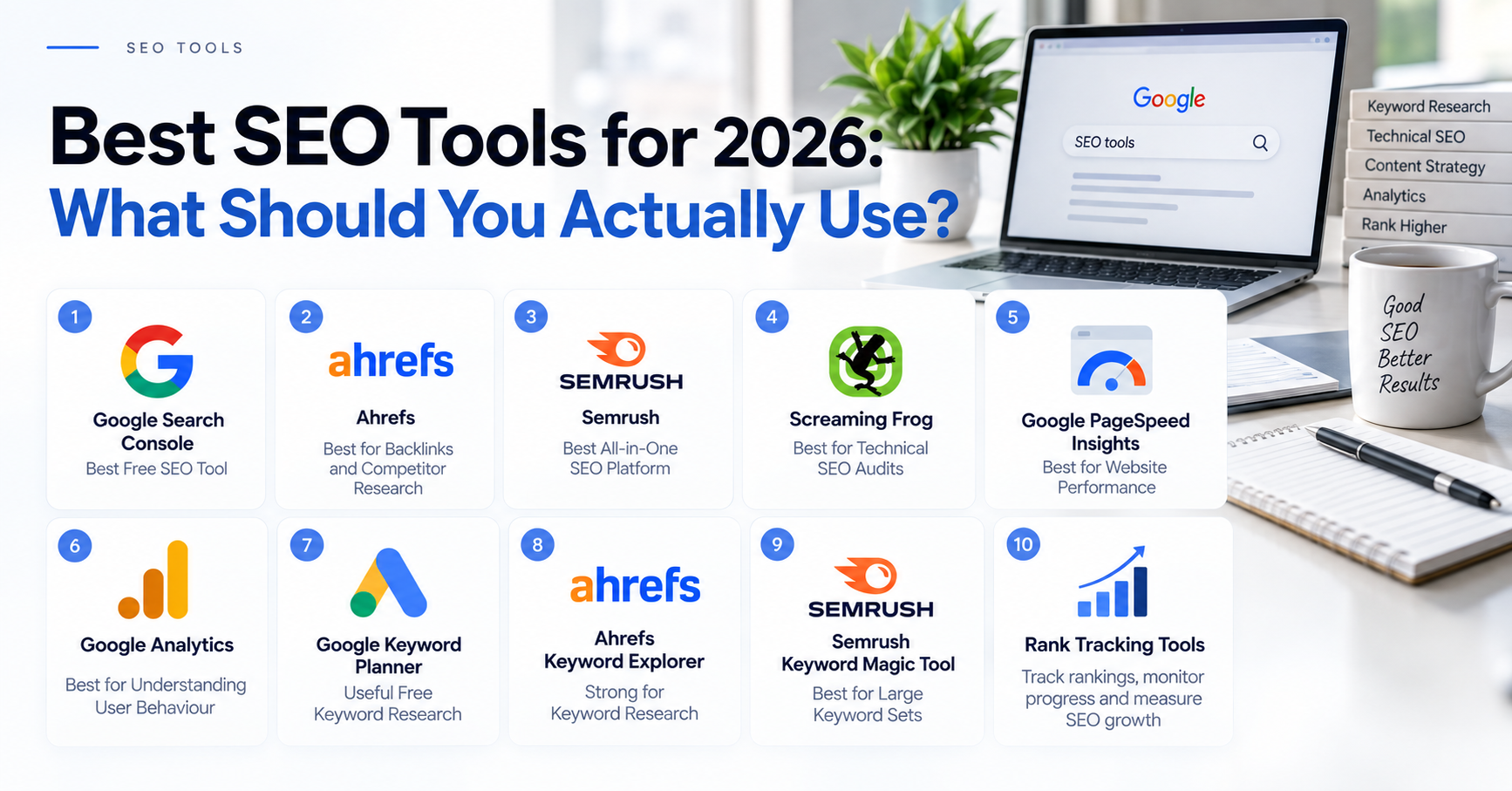
SEO tools have become more powerful than ever, but that has also created a new problem: there are now too many options.
Some tools focus on backlinks. Others are better for keyword research, technical SEO, content optimization, rank tracking, or website performance. In 2026, there is no single tool that does everything perfectly.
The better question is not:
“What is the best SEO tool?”
It is:
“What is the best SEO tool for the job I am trying to do?”
This guide compares some of the most useful SEO tools for modern SEO and explains where each one fits into a professional SEO workflow.
1. Google Search Console – Best Free SEO Tool
If you own or manage a website, Google Search Console should be one of the first tools you set up.
Unlike third-party SEO platforms, Search Console provides data directly from Google about how your website performs in Google Search.
You can use it to monitor:
search clicks
impressions
average ranking position
click-through rate
indexed pages
crawling issues
Core Web Vitals
sitemap status
Search Console is especially valuable because it shows what is actually happening to your website in Google Search rather than relying only on estimates.
For example, if an article suddenly loses traffic, Search Console can help you identify:
which queries dropped
which pages lost impressions
whether rankings declined
whether indexing changed
For website owners, this makes Google Search Console one of the most important SEO tools available.
2. Ahrefs – Best for Backlinks and Competitor Research
Ahrefs remains one of the strongest tools for backlink analysis and competitive SEO research.
Its Site Explorer can be used to analyze:
backlinks
referring domains
organic keywords
top-performing pages
competitor traffic
link growth
Ahrefs also offers tools for:
keyword research
rank tracking
content gap analysis
technical SEO audits
link intersect analysis
According to Ahrefs, its Site Audit can identify more than 170 technical and on-page SEO issues, while Site Explorer provides visibility into backlinks, organic search traffic, and keyword rankings.
If your SEO strategy focuses heavily on:
backlink building
competitor analysis
domain authority
content gaps
Ahrefs is one of the best tools available.
3. Semrush – Best All-in-One SEO Platform
Semrush is one of the strongest options for SEO teams that want most of their workflow inside one platform.
Its SEO Toolkit includes tools for:
keyword research
keyword gap analysis
backlink analysis
technical SEO
position tracking
content planning
competitor research
on-page SEO
Semrush currently offers more than 20 SEO tools and reports in its SEO Toolkit.
One of its biggest advantages is competitor research.
You can compare domains to identify:
keywords competitors rank for
missing keyword opportunities
backlink gaps
top-performing competitor pages
ranking changes
Semrush has also expanded its tools around AI search visibility, reflecting how SEO is beginning to include visibility in AI-generated answers as well as traditional search results.
For agencies and larger SEO teams, Semrush can be a very practical all-in-one option.
4. Screaming Frog – Best for Technical SEO Audits
For technical SEO, Screaming Frog SEO Spider remains one of the most useful tools.
Unlike Ahrefs or Semrush, Screaming Frog behaves more like a search engine crawler.
You can crawl a website and identify issues such as:
broken links
redirect chains
duplicate titles
missing descriptions
canonical problems
orphan pages
incorrect status codes
hreflang issues
It is particularly useful when auditing large websites.
For example, you may have 5,000 pages and want to know:
which pages return 404
which pages have duplicate titles
which pages are noindex
which URLs redirect multiple times
A crawler can identify these problems much faster than manual checking.
For serious technical SEO work, Screaming Frog is difficult to replace.
5. Google PageSpeed Insights – Best for Website Performance
SEO is not only about keywords and backlinks.
Performance also matters.
Google PageSpeed Insights helps identify performance issues affecting both mobile and desktop users.
It is especially useful for checking:
Largest Contentful Paint
Interaction to Next Paint
Cumulative Layout Shift
image loading
JavaScript performance
render-blocking resources
For WordPress and Next.js websites, PageSpeed Insights should be part of regular technical SEO checks.
A page does not need a perfect 100 score to rank, but poor performance can create a weaker user experience and contribute to poor Core Web Vitals.
6. Google Analytics – Best for Understanding User Behaviour
Google Search Console tells you how users find your website.
Google Analytics helps explain what happens after they arrive.
You can analyze:
traffic sources
landing pages
engagement
conversions
user journeys
campaigns
This becomes important because SEO success should not be measured only by rankings.
Imagine two pages.
Page A generates 5,000 organic visits but almost no conversions.
Page B generates 1,000 visits and 100 leads.
From a business perspective, Page B may be much more valuable.
That is why SEO data should always be connected to website behaviour and conversion data.
7. Google Keyword Planner – Useful Free Keyword Research
Google Keyword Planner is primarily designed for Google Ads, but it can still be useful for SEO keyword research.
It provides information such as:
keyword ideas
search demand
competition
advertising estimates
It is particularly useful when combined with other SEO tools.
You could use Keyword Planner for initial ideas and then use Ahrefs or Semrush to analyze:
keyword difficulty
ranking competitors
backlink requirements
traffic potential
This gives you a better overall view of keyword opportunities.
8. Ahrefs Keyword Explorer – Strong for Keyword Research
For deeper keyword analysis, Ahrefs Keywords Explorer provides:
search volume
keyword difficulty
traffic potential
SERP analysis
related keywords
keyword clusters
Ahrefs says its Keywords Explorer covers billions of searchable keyword ideas and can be used to discover topics and keyword opportunities across markets.
One particularly useful concept is traffic potential.
A keyword may only have moderate search volume, but the page ranking for that keyword may also rank for hundreds of related queries.
That means keyword decisions should not be based on volume alone.
9. Semrush Keyword Magic Tool – Best for Large Keyword Sets
Semrush Keyword Magic Tool is especially useful when you start with one broad topic and need to expand it into many keyword ideas.
For example:
Starting keyword:
WordPress SEO
The tool may help you discover topics such as:
WordPress SEO plugins
WordPress technical SEO
WordPress speed optimization
WordPress SEO checklist
WordPress sitemap SEO
Semrush states that its Keyword Magic Tool includes billions of keywords and supports filtering by intent, search volume, difficulty, and related terms.
This makes it very useful for building content clusters.
10. Rank Tracking Tools
You should also monitor whether your SEO efforts are actually improving rankings.
Both Ahrefs and Semrush include rank tracking tools.
You can track:
target keywords
ranking position
desktop rankings
mobile rankings
country-specific rankings
competitor rankings
Ahrefs Rank Tracker, for example, supports tracking rankings across desktop and mobile in many countries and can measure metrics such as Share of Voice.
Rank tracking is especially useful for long-term SEO campaigns.