
Using AI for SEO and GEO: How Agent Skills Become a Website Growth System
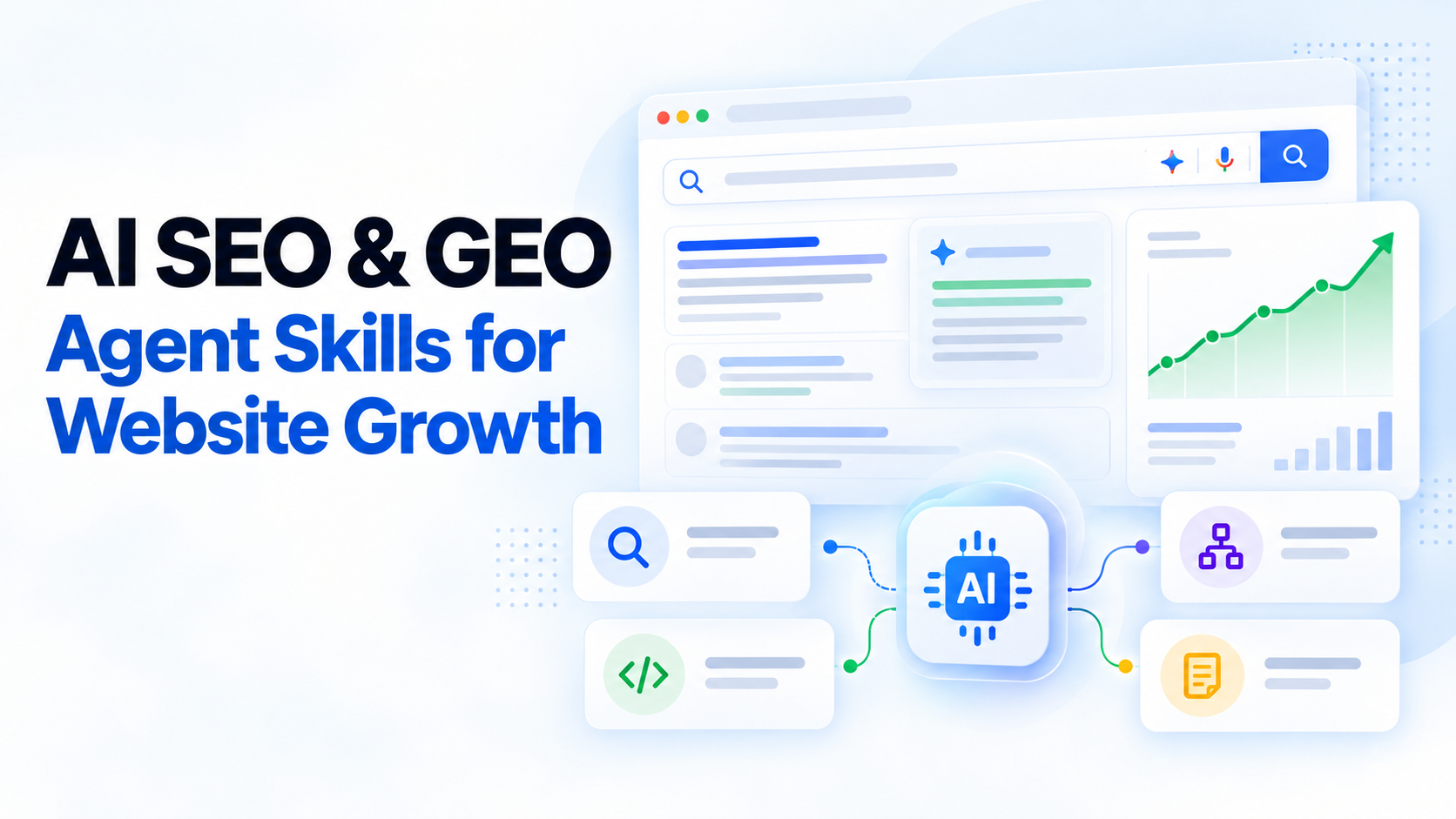
AI-powered SEO uses language models and task-specific agents to accelerate research, analysis, implementation, and monitoring while humans remain responsible for strategy, accuracy, and publication. Generative Engine Optimization (GEO) extends that work to AI-generated search experiences, but it does not replace SEO.
Google’s current guidance is direct: generative search features are rooted in the same core ranking and quality systems used by Search. Google describes GEO and AEO as common industry terms, but says optimizing for generative AI search is still optimizing for the search experience. Useful content, crawlability, technical clarity, and a strong page experience remain the foundation.
The short version: use AI to operate a rigorous SEO system—not to manufacture pages at scale. Build content that deserves to be retrieved, make the website easy to crawl and understand, and use specialized skills to repeat the work consistently.
What changes when AI becomes part of SEO?
SEO teams already work across discovery, content, technical implementation, authority, and measurement. AI does not create a new discipline. It changes the cost and speed of many tasks inside the discipline.
An agent can compare title tags across hundreds of pages, cluster a keyword set, draft schema, turn crawl findings into developer tickets, or create a content brief from primary sources. It can also make mistakes quickly: inventing evidence, applying generic advice, flattening a brand voice, or publishing changes that were never reviewed.
The best operating model gives AI a bounded job, trusted inputs, explicit acceptance criteria, and a verification step. That is where skills become useful.
What is an AI agent skill?
An agent skill is a reusable package of instructions, references, scripts, and sometimes tool integrations for a specific job. Instead of pasting the same SEO checklist into every conversation, you give the agent a defined workflow it can load when the task matches.
Anthropic’s official documentation describes skills as reusable, filesystem-based resources that give agents domain-specific workflows and context. A skill commonly starts with a SKILL.md file and can include references, examples, and scripts. The important idea is not the file format; it is progressive, task-specific expertise.
A Claude SEO suite, for example, may contain separate skills for technical SEO, content quality, schema, sitemaps, local SEO, images, GEO, and Search Console analysis. A Codex setup can follow the same pattern. The model remains general-purpose, while each skill defines how a particular job should be executed and checked.
Important boundary: installing a Claude SEO skill does not install a ranking feature into your public website. The skill lives in the agent’s working environment. It helps the agent inspect or change the website through approved tools. The website still needs real HTML, content, metadata, structured data, performance work, and publishing infrastructure.
Where AI skills fit in a website stack
Think in three layers:
- The website layer: pages, internal links, server responses, metadata, schema, media, performance, accessibility, and analytics.
- The evidence layer: Search Console, analytics, crawl data, rankings, customer questions, product knowledge, and primary sources.
- The agent layer: skills that turn evidence into audits, briefs, patches, articles, QA, and reports.
The agent layer should read evidence and improve the website layer. It should never be treated as a substitute for either one.
A practical AI SEO and GEO workflow
1. Start with a question, not a content quota
Define the audience, decision, and outcome. “Publish ten AI SEO pages” is a production target. “Help technical marketers decide which parts of SEO to automate safely” is a useful problem.
2. Give the agent primary evidence
Connect crawl results, Search Console queries, existing content, product documentation, and authoritative external sources. A skill should state which sources outrank others when they disagree.
3. Select the narrowest skill
Use a technical SEO skill for indexation or rendering, a schema skill for JSON-LD, a content skill for usefulness and E-E-A-T, and a GEO skill for passage-level clarity and citation readiness. A broad “do SEO” prompt makes review harder.
4. Require an evidence trail
Every recommendation should point to a URL, report, code location, or observed behavior. Scores from third-party tools should be labeled as heuristics, not Google ranking signals.
5. Separate draft, publish, and verify
Creating content is different from approving it. After publication, verify the live URL, canonical, indexability, structured data, links, and mobile rendering.
6. Measure outcomes, not output
Track qualified impressions, clicks, conversions, coverage, and citations where reliable data exists. Google now exposes dedicated generative AI visibility reporting in Search Console, allowing AI-search exposure to be evaluated alongside classic performance.
How to make content citation-ready
AI systems retrieve passages, compare sources, and generate grounded answers. A page becomes easier to retrieve and cite when it is genuinely useful and structurally clear.
- Answer the main question early with a precise definition.
- Use descriptive headings that match real sub-questions.
- Attribute changeable claims to primary sources.
- Include first-hand evidence, examples, or original analysis.
- Use tables and lists when they make comparisons easier.
- Keep the page crawlable, indexable, and eligible for snippets.
- Use relevant Article, Person, Organization, or Product schema where appropriate.
Do not confuse citation readiness with writing for machines. Google says there is no requirement to create special AI markup, rewrite pages in a special style, or split every idea into tiny chunks. It also says llms.txt does not help visibility in Google Search. These files may serve other systems, but they are not a replacement for a useful website.
Useful skills to add first
- Technical SEO: crawlability, indexation, canonicals, rendering, status codes, and Core Web Vitals.
- Content quality: search intent, usefulness, E-E-A-T, originality, readability, and internal linking.
- GEO: entity clarity, passage-level answers, source attribution, and multi-platform visibility checks.
- Schema: detect, validate, and generate supported JSON-LD.
- Sitemap: validate URL coverage, freshness, and segmentation.
- Performance: measure field and lab data, then map findings to implementation work.
- Publishing QA: verify the live page after every consequential change.
Claude SEO-style suites are helpful because they keep these jobs separate while sharing a common evidence standard. The same architecture works in Codex or another capable agent environment: small, discoverable skills are easier to test, update, and trust than one enormous prompt.
What AI should never be allowed to fake
An AI workflow should never invent Search Console access, customer quotes, tests, traffic results, backlinks, author experience, or approval. It should not claim that a page is indexed because a sitemap was submitted, or that a recommendation improved rankings before enough evidence exists.
Google’s people-first content guidance offers a useful editorial check: make the who, how, and why clear. Who created the content? How was it produced and reviewed? Why does it exist? AI assistance can be part of an honest answer, but it cannot create experience the author does not have.
A simple implementation plan
- Choose one real SEO workflow you repeat every week.
- Write its inputs, decisions, output, and acceptance criteria.
- Turn that procedure into a narrowly scoped skill.
- Run it on one page and review every recommendation.
- Let the agent prepare changes, but keep publication controlled.
- Verify the live result and save the evidence.
- Improve the skill from the failure points you observed.
This approach is slower than pressing “generate 100 pages,” and much faster than repairing 100 weak pages later.
The future is not SEO versus GEO
The useful distinction is not traditional search versus AI search. It is commodity content versus content worth retrieving. Search interfaces will keep changing, but sites still need to be discoverable, understandable, trustworthy, and satisfying.
AI agents and skills give small teams leverage. They can turn good practices into consistent operations and help a website improve every week. The durable advantage remains human: choosing the right problems, contributing real experience, and deciding what deserves to be published.