
AI for SEO: A Practical Workflow That Keeps Humans in Control
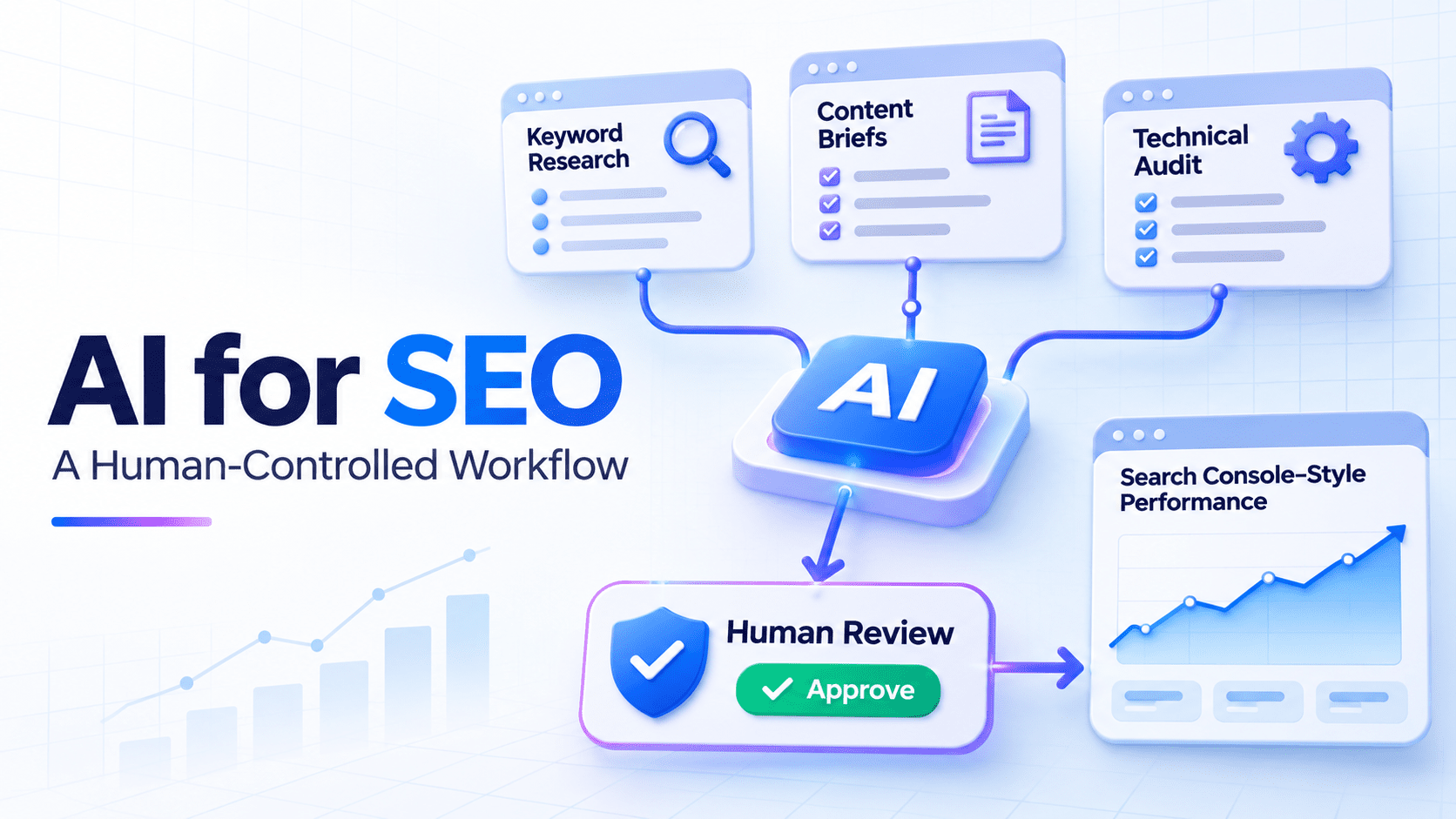
AI for SEO works best when it accelerates evidence-based decisions while people remain responsible for strategy, accuracy, originality, and publication. The goal is not to ask a model to “do SEO.” The goal is to build a controlled workflow that turns reliable inputs into useful research, better pages, safer technical changes, and measurable outcomes.
Google does not prohibit AI-assisted content. Its guidance focuses on the value and purpose of the result. Using automation primarily to manipulate rankings, or generating many low-value pages, can violate Google’s spam policies. Using AI to research a topic, structure original material, identify patterns, or improve a human-led process can be useful when the finished work is accurate, relevant, and genuinely helpful.
The practical rule: let AI handle repetition and pattern detection. Keep human judgment at every point where a mistake could affect trust, rankings, customers, or the public website.
What does AI for SEO actually mean?
AI for SEO is the use of language models, agents, and automation inside established search optimization work. It can support keyword discovery, search-intent analysis, content briefs, internal linking, metadata, schema, technical audits, and performance reporting.
It does not create a new ranking signal. Google’s guidance for AI Overviews and AI Mode says the same foundational SEO practices remain relevant. A page still needs to be crawlable, indexable, useful, technically clear, and eligible to appear with a snippet. There is no special AI schema or secret machine-readable file that guarantees inclusion.
This is why the best AI SEO system begins with SEO fundamentals rather than a list of prompts.
The five-stage human-controlled AI SEO workflow
1. Define the decision before using AI
Start with a business or user question. A weak task is “write an article about technical SEO.” A stronger task is “help WordPress site owners identify which performance fixes are most likely to improve mobile experience without breaking the site.”
The stronger version establishes an audience, a problem, and a useful outcome. It also gives the reviewer a clear way to judge whether the work is complete.
- Who is the page for?
- What question should it answer?
- What evidence is required?
- What action should the reader be able to take?
- How will success be measured after publication?
2. Ground the work in trusted evidence
A model can produce fluent explanations without knowing whether they are current or correct. Give it evidence instead of asking it to improvise. Useful inputs include Search Console queries, analytics, crawl results, product documentation, existing pages, customer questions, and primary-source guidance.
For Google Search claims, use Google Search Central as the first reference. For website performance, combine PageSpeed Insights with real-user Core Web Vitals data where available. For your own organic performance, Search Console is the source of truth for impressions, clicks, queries, and pages.
AI should summarize and compare this evidence, not replace it.
3. Give AI a narrow job
Broad prompts create broad, difficult-to-review answers. Assign one bounded job at a time and define the expected output.
| SEO job | Good AI task | Human responsibility |
|---|---|---|
| Keyword research | Group verified queries by intent and page type | Choose priorities and reject misleading clusters |
| Content brief | Map questions, entities, sources, and internal links | Add experience, point of view, and original value |
| Technical audit | Classify crawl findings by pattern and severity | Confirm the issue and approve implementation |
| Schema | Draft JSON-LD from visible page facts | Validate accuracy and feature eligibility |
| Reporting | Explain changes in clicks, impressions, and conversions | Decide what the data means for the business |
This approach is easier to verify than asking one agent to research, write, optimize, publish, and report in a single step.
4. Require human review before publication
Google’s guidance on generative AI content says automatically generated material should be manually checked for accuracy and trustworthiness. That review includes titles, meta descriptions, structured data, and image alt text—not only the body copy.
A useful review checks four layers:
- Accuracy: Are facts, dates, names, quotes, and technical instructions correct?
- Originality: Does the page add experience, analysis, examples, or a useful framework?
- Intent: Does it solve the reader’s problem without forcing another search?
- Risk: Could the advice harm a site, mislead a reader, or expose private information?
Human review should be a release gate, not a note added after publication.
5. Verify the live result and measure outcomes
Publishing is not the final step. Check the actual URL on desktop and mobile. Confirm the canonical URL, indexability, headings, internal links, structured data, images, and page speed. Then monitor whether the page earns qualified impressions, clicks, engagement, conversions, or citations.
Google recommends using Search Console and Google Analytics together: Search Console explains how people discover the page in Search, while Analytics explains what happens after they arrive.
Where AI creates the most SEO value
Research synthesis
AI can compare a large set of verified documents and turn them into a concise map of themes, disagreements, entities, and unanswered questions. This is especially useful when the source set is defined in advance.
Content briefs
A strong brief is more than a keyword list. AI can organize primary questions, supporting questions, internal-link opportunities, required evidence, likely objections, and a logical heading structure. The writer still needs to contribute real experience and a point of view.
Content refreshes
AI can compare an older page with current primary sources and flag claims that may be outdated. It can also identify missing examples, broken links, redundant sections, or passages that no longer match search intent.
Internal linking
An agent can scan titles, topics, and existing anchors to suggest relevant links. Each suggestion should be checked in context. A link is useful when it helps the reader continue the task, not simply because two pages share a keyword.
Technical pattern detection
Crawl exports often contain thousands of rows. AI can help group duplicate titles, redirect chains, canonical conflicts, missing metadata, and template-level errors. It should produce evidence and examples so a developer or SEO specialist can confirm the pattern before changing the site.
Structured data drafting
AI can draft Article, Person, Organization, Product, or Breadcrumb structured data from visible facts. The output must match the page, follow the relevant feature policies, and pass validation. Never allow a model to invent reviews, ratings, credentials, prices, or authorship.
What AI should not control by itself
- Publishing large numbers of pages without editorial review
- Making unsupported medical, financial, legal, or safety claims
- Changing canonicals, redirects, robots rules, or noindex directives at scale
- Inventing author identities, expertise, citations, or first-hand experience
- Sending automated queries to Google in violation of its policies
- Rewriting competitor content without adding substantial original value
- Judging success from an AI tool’s score instead of real search and business data
Google defines scaled content abuse by purpose and value, not only by the technology used. Generating many unoriginal pages to manipulate rankings is risky whether the pages were made by AI, templates, scripts, or people.
A practical AI SEO quality checklist
Use this checklist before publishing any AI-assisted SEO page:
- The main question is answered clearly near the beginning.
- Every changeable claim has a reliable source.
- The content contains original analysis, experience, examples, or a useful framework.
- The author and purpose of the page are clear.
- The title, description, headings, links, schema, and alt text were manually reviewed.
- The page is crawlable, indexable, mobile-friendly, and fast enough for real users.
- Internal links connect the page to a relevant topic cluster.
- The live page was checked after publishing.
- Search Console and conversion metrics will be monitored.
How this fits with GEO and AI search
Generative Engine Optimization is not a replacement for SEO. Google says its generative search experiences are rooted in core Search ranking and quality systems. Clear answers, source attribution, original evidence, descriptive headings, and strong technical access can make content easier to retrieve and understand, but they are also good SEO fundamentals.
Avoid supposed shortcuts such as unnecessary AI-only markup, mechanical “content chunking,” or manufactured brand mentions. Focus on building pages that deserve to be used as sources.
For a deeper explanation of agents, GEO, and reusable skills, read Using AI for SEO and GEO: How Agent Skills Become a Website Growth System. You may also find the guides to Google Search Console, technical SEO, and PageSpeed useful when building the measurement and verification layers.
Final takeaway
AI can make SEO research, analysis, drafting, and quality assurance dramatically faster. Speed is valuable only when the workflow preserves accuracy and judgment.
Start with a real user problem. Ground the work in trusted evidence. Give AI a narrow job. Require human approval. Verify the live result. Measure what happens next.
That is how AI becomes a reliable SEO operator instead of a content-production shortcut.
Primary sources
- Google Search guidance on generative AI content
- Creating helpful, reliable, people-first content
- Spam policies for Google Web Search
- AI features and your website
- Using Search Console and Google Analytics data for SEO
Editorial note: AI assisted with research organization and drafting. The article was reviewed against the linked primary sources before publication.