
Zero-Click Search in the AI Era: What SEO Should Measure Beyond Traffic
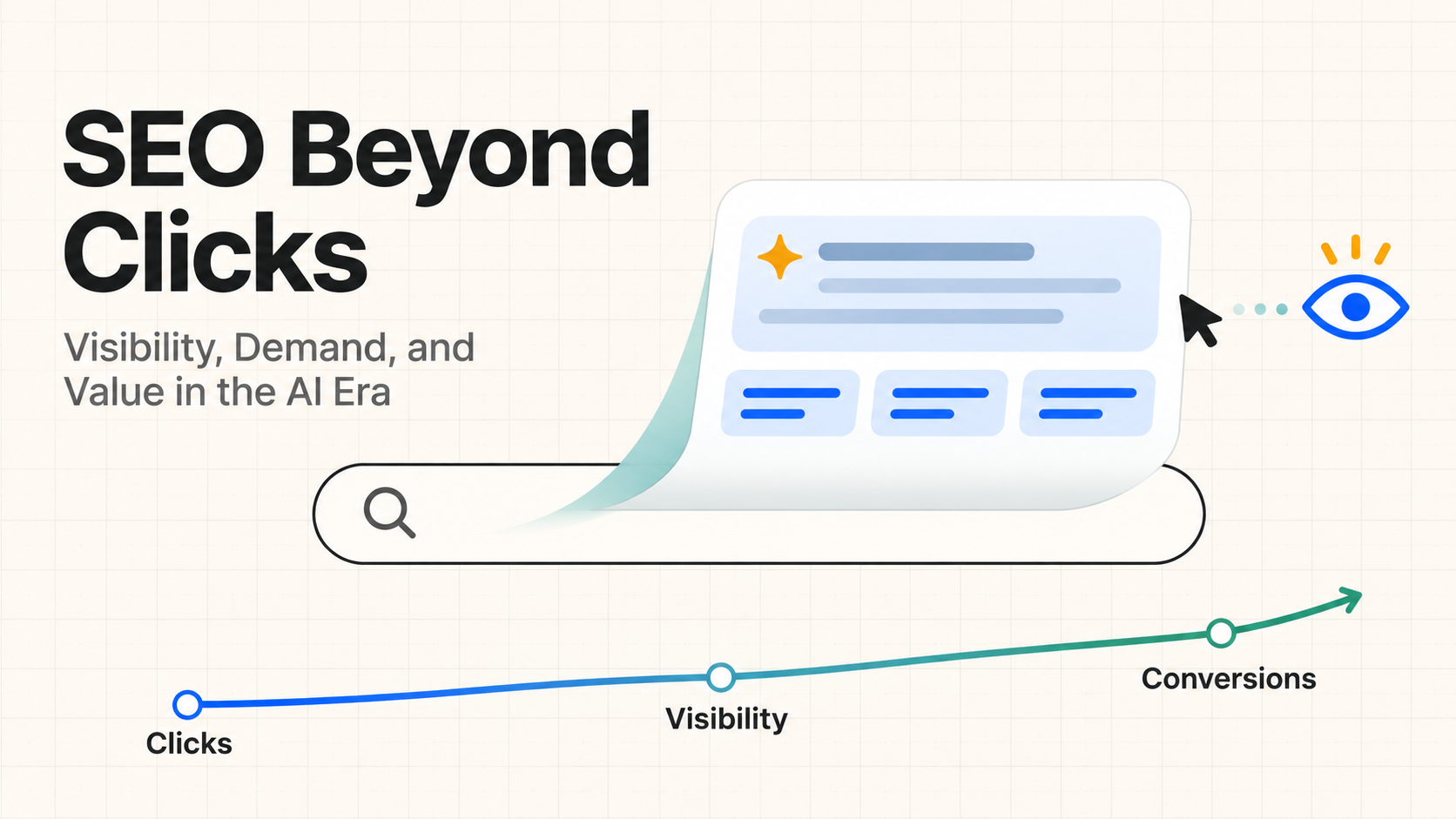
Zero-click search does not make SEO worthless. It makes traffic an incomplete measure of SEO. In an AI-mediated search journey, a person may see your brand, learn from your page, compare your product, or remember your expertise without immediately visiting your website. That visibility can still influence a later search, direct visit, lead, or purchase.
The practical response is not to stop measuring clicks. It is to stop treating clicks as the entire outcome. Modern SEO reporting needs to connect search visibility, page discovery, brand demand, qualified visits, and business results.
The measurement shift: traffic tells you who arrived. Visibility tells you where the brand appeared. Conversions tell you whether the work created value. A useful SEO dashboard needs all three.
What is zero-click search?
A zero-click search is a search session in which the user does not click through to an external website. The result page may answer the question directly through a featured snippet, knowledge panel, local result, calculator, AI Overview, or another search feature.
“Zero click” does not always mean “zero value.” A user may get a phone number from a local result, see a brand cited in an AI-generated answer, learn a definition, or decide which company to search for later. At the same time, some queries that once generated visits may now satisfy users without a click. Both realities can be true.
This is why broad claims that SEO is either “dead” or “unchanged” are not useful. The effect depends on the query, intent, industry, device, result type, and role your page plays in the decision.
How AI answers change the search journey
Classic SEO reporting often assumes a simple sequence: ranking, impression, click, visit, conversion. AI answers can make that sequence less direct.
A person might ask a complex question, read a generated response with several supporting links, refine the question, then search for one cited brand by name. Another person may click immediately. A third may remember the recommendation and return through a direct visit days later.
Google explains that AI Overviews and AI Mode use links to supporting web resources. Search Console counts clicks on those external links as clicks, and applies standard impression rules to links shown in an AI Overview. Google also introduced dedicated Generative AI performance reports in 2026, allowing site owners to examine visibility across AI features by page, country, device, and date.
The reporting is improving, but the customer journey can still cross channels and sessions. That makes a layered measurement model more useful than a single traffic chart.
The four layers of SEO measurement
1. Search visibility
Visibility measures how often and where your website appears. It is the widest layer of the model.
- Total impressions and impression trends
- Query and topic coverage
- Pages earning new visibility
- Country and device distribution
- Search appearance and AI-feature visibility
- Share of relevant branded and non-branded demand
Google notes that an impression means a link to your site was seen, or could potentially be seen under the rules for that result type. More impressions are not automatically better. Meaningful impressions come from people who could reasonably benefit from the page.
A rise in impressions with flat clicks may mean the site is gaining broader visibility, appearing for less-qualified queries, or being shown in result formats that satisfy more of the task before a click. The next layer helps distinguish those possibilities.
2. Search engagement
Engagement measures the transition from visibility to a website visit.
- Clicks
- Click-through rate
- Landing pages receiving search traffic
- Query-to-page alignment
- Changes by device, country, and search appearance
CTR is useful, but it needs context. A lower CTR can reflect a weaker title, a mismatch in intent, more competitive result features, or a large increase in upper-funnel impressions. It should be investigated, not interpreted automatically as failure.
Average position also needs caution. Google describes it as the average position of the topmost result from your property or page. Search results are complex, and position values differ across queries, locations, devices, and result types. Trend changes are often more useful than one absolute number.
3. On-site quality
Once a person arrives, the question changes. Did the page help them?
- Engaged sessions
- Scroll depth or content completion
- Internal navigation to relevant pages
- Return visits
- Downloads, sign-ups, or other micro-conversions
- Page experience and Core Web Vitals
Google recommends using Search Console and Google Analytics together because they measure different parts of the journey. Search Console is the source of truth for performance in Google Search. Analytics describes behavior after the user reaches the website.
High traffic with weak engagement may indicate the page ranks for the wrong intent, answers the question poorly, loads slowly, or fails to provide a clear next step.
4. Business outcomes
The final layer connects SEO to value.
- Qualified leads
- Revenue or assisted revenue
- Product trials and account registrations
- Calls, bookings, and store visits
- Newsletter subscriptions
- Branded search growth
- Cost per qualified organic acquisition
Not every SEO page should generate a direct sale. An educational guide may create awareness, answer objections, earn links, or assist a later conversion. The page should still have a defined role in the customer journey.
A measurement table for AI-era SEO
| Question | Primary metric | Supporting evidence |
|---|---|---|
| Are we being discovered? | Qualified impressions | Queries, pages, countries, devices, AI visibility |
| Do people choose us? | Clicks and CTR | Titles, intent match, search appearance |
| Does the page help? | Engaged visits | Scroll, internal navigation, return visits |
| Does SEO create value? | Conversions | Lead quality, revenue, assisted journeys |
| Is the brand becoming easier to find? | Branded demand | Branded queries, direct visits, repeat users |
This model prevents a common reporting mistake: celebrating visibility that never becomes useful, or dismissing useful visibility simply because it did not create an immediate click.
Why branded search deserves more attention
AI-assisted discovery may create demand that appears later as a branded query. If someone sees your company cited, closes the search, and returns by searching your name, the original exposure and later visit may not be joined neatly in one report.
Watch for changes in:
- Impressions and clicks for brand-name queries
- Brand-plus-product or brand-plus-topic searches
- Direct visits to key landing pages
- Returning users
- Assisted conversions
- Sales or support conversations mentioning search or AI tools
These signals do not prove that an AI answer caused the demand. They provide context. Use annotations, surveys, CRM notes, and time-based comparisons before making causal claims.
How to report AI-search visibility honestly
AI visibility tools can be useful, but their outputs are samples. Results can vary by prompt, model, location, personalization, and time. A third-party “visibility score” is not a Google ranking metric.
A defensible report separates first-party observations from estimates:
- First-party search data: Search Console clicks, impressions, pages, queries, and official Generative AI reports.
- First-party site data: analytics, conversions, CRM outcomes, and revenue.
- Third-party observations: sampled citations, prompt tracking, competitor comparisons, and rank monitoring.
- Qualitative evidence: customer feedback, sales calls, community mentions, and brand searches.
Label each source clearly. Do not combine them into one number that appears more precise than the evidence allows.
What not to do when clicks decline
A decline deserves investigation, not an instant conclusion that AI answers are responsible.
- Do not blame AI without checking queries, pages, devices, countries, and dates.
- Do not publish more pages simply to compensate for declining traffic.
- Do not change titles across the entire site without testing the affected templates.
- Do not judge performance from average position alone.
- Do not treat every impression as equally valuable.
- Do not promise that GEO tactics will restore every lost click.
Compare periods, segment the data, inspect the live results, and review whether the page still provides the best answer for the user’s current need.
A monthly SEO dashboard that stays useful
A compact monthly report can use five sections:
- Visibility: qualified impressions, new query coverage, and AI-feature exposure.
- Engagement: clicks, CTR, landing pages, and significant changes by segment.
- Experience: engaged visits, page speed, navigation, and content completion.
- Outcomes: leads, revenue, subscriptions, and assisted conversions.
- Decisions: what to improve, test, consolidate, update, or stop.
The final section matters most. A report should guide action. If it only describes charts, it is documentation rather than management.
SEO is still about earning the next action
The next action is not always a click. It may be recognition, trust, comparison, a branded search, a return visit, or a conversion. But visibility without a path to value is not enough either.
Keep measuring clicks. Add the signals that explain what happens before and after them. Connect Search Console to analytics and business outcomes. Treat AI citations and visibility as part of the evidence, not as a replacement for performance.
That is a more realistic way to measure SEO in an era where search results increasingly answer, recommend, and summarize.
Related reading
- AI for SEO: A Practical Workflow That Keeps Humans in Control
- Using AI for SEO and GEO: How Agent Skills Become a Website Growth System
- Google Search Console: The Free SEO Tool You Can’t Afford to Ignore
- GA4 and SEO: How Google Analytics 4 Supports Your SEO Strategy
Primary sources
- Introducing Search Generative AI performance reports in Search Console
- Google: What are impressions, position, and clicks?
- Search Console Performance report overview
- Using Search Console and Google Analytics data for SEO
Editorial note: AI assisted with research organization and drafting. The article was reviewed against the linked Google documentation before publication.