
Content Refresh in the AI Search Era: Update Pages Without Faking Freshness
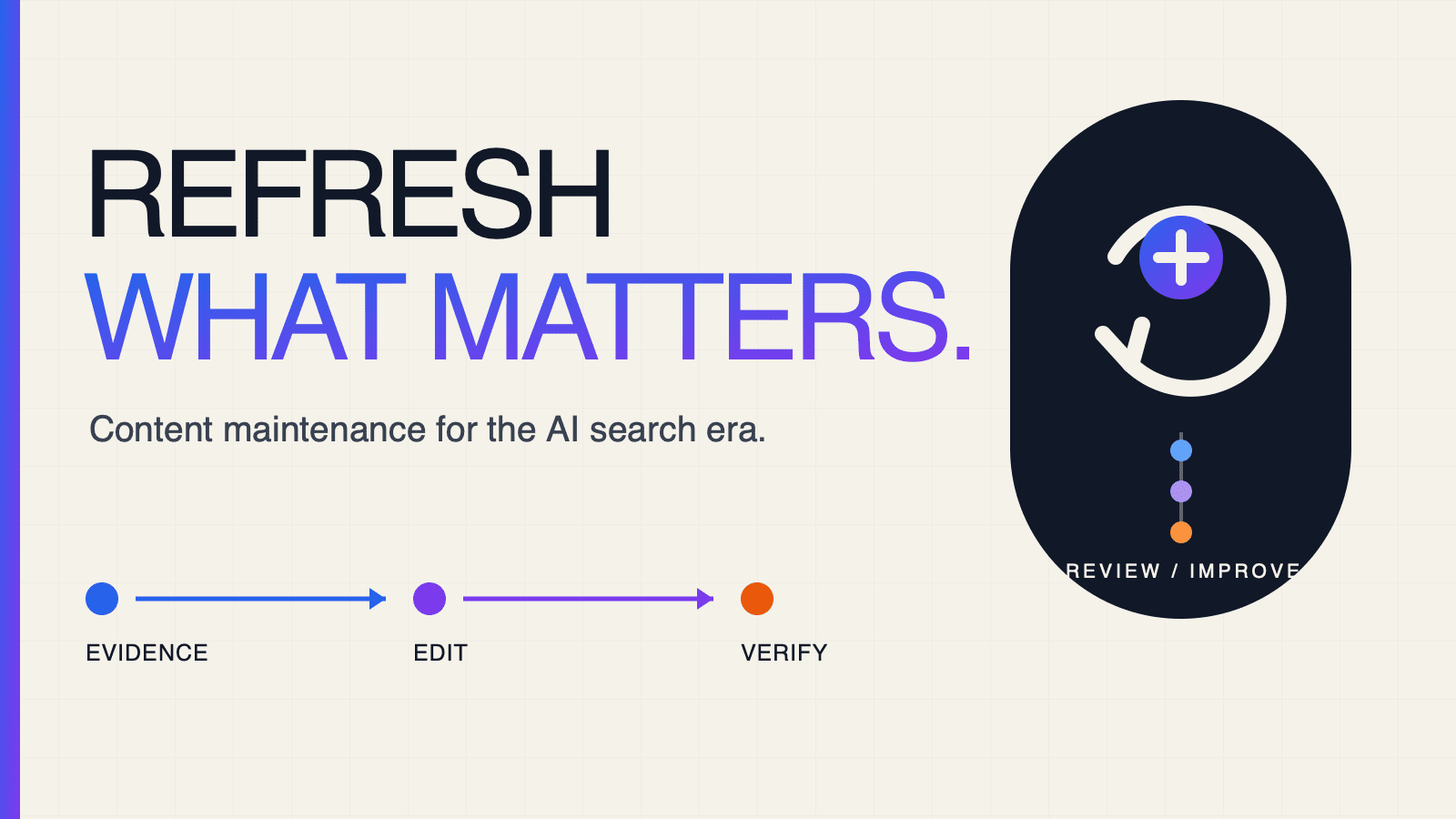
Content refresh in the AI search era should be driven by evidence, not by a publishing calendar. Update a page when its facts, user needs, competitive context, or product reality have materially changed. Do not change the date, add a few sentences, or run every paragraph through an AI tool simply to make an old URL look new.
AI makes large-scale rewriting easy, but it does not make every rewrite useful. The strongest refresh process starts with search and business data, identifies the reason a page is underperforming, improves only what needs to change, and verifies the result after publication.
The short version: freshness is not a style. It is evidence that a page still gives an accurate, complete, and satisfying answer.
Why content refresh has become an AI problem
Content teams have always updated older pages. AI changes the economics of the work. A model can summarize a page, suggest missing sections, compare competing documents, rewrite stale examples, and generate dozens of proposed updates in minutes.
That speed creates two opposite opportunities:
- Better maintenance: teams can find outdated claims, broken links, missing evidence, and inconsistent terminology across a large library.
- Scaled cosmetic updates: teams can also rewrite thousands of pages without improving accuracy, originality, or usefulness.
Google’s people-first content guidance specifically warns against changing page dates when the content has not substantially changed and against adding or removing large amounts of content merely to make a site appear fresh. The problem is not the use of AI. The problem is producing search-engine-first changes that do not help the reader.
A refresh is not the same as a rewrite
A rewrite changes language. A refresh restores the page’s fitness for its job.
Sometimes the best refresh is a substantial rewrite. A product category may have changed, the audience may be asking different questions, or the original structure may no longer match search intent. In other cases, the page needs only a corrected statistic, a new screenshot, a stronger example, or a repaired internal link.
Before editing, classify the situation:
- Fact decay: prices, features, rules, interfaces, dates, or recommendations are no longer accurate.
- Intent drift: the queries and expectations around the topic have changed.
- Coverage gap: the page answers the main question but misses an important decision, constraint, or follow-up.
- Experience gap: the page repeats common knowledge without first-hand evidence, examples, or judgment.
- Technical decay: links, media, schema, rendering, canonicals, or page performance have degraded.
- No real problem: the page is stable, accurate, useful, and does not need an update.
The last category matters. Good maintenance includes deciding not to touch a page.
Use evidence to choose pages
A content calendar can schedule review, but it should not decide the edit. Start with signals that reveal a real change.
Search performance signals
In Search Console, compare equivalent periods and inspect pages, queries, countries, devices, and search appearances. Google recommends using a longer window to understand seasonality and comparing the affected period with a similar previous period when diagnosing traffic drops.
Useful patterns include:
- Impressions remain stable while clicks decline.
- A page loses queries that it used to answer well.
- New related queries appear but the page does not cover them.
- Performance declines on one device or country rather than everywhere.
- A seasonal decline repeats at the same time every year.
Do not assume every drop is a content-quality problem. Demand, seasonality, SERP design, technical issues, competition, and site-wide changes can produce similar charts.
Business and audience signals
Search data explains discovery, not the complete customer problem. Review support tickets, sales questions, on-site search, product changes, conversion paths, comments, and customer interviews. A page may rank well and still create confusion or attract the wrong audience.
This broader measurement approach is covered in Zero-Click Search in the AI Era: What SEO Should Measure Beyond Traffic.
Page-level decay signals
A crawler or content inventory can flag old dates, broken outbound links, missing images, redirecting internal links, orphan pages, duplicate titles, or schema errors. AI can help prioritize the list, but the decision should still be tied to user impact.
A five-step AI-assisted refresh workflow
1. Define the page’s job
Write one sentence describing what the page helps a specific visitor do. For example: “Help a small website owner decide whether a traffic decline requires a content update or a technical investigation.”
This prevents the refresh from becoming a random collection of related keywords.
2. Build an evidence packet
Give the AI system the current page, relevant Search Console comparisons, verified product information, primary sources, internal content, and known customer questions. Separate trusted facts from hypotheses.
A useful evidence packet might contain:
- The page’s current HTML and metadata.
- Top and declining queries for two comparable periods.
- Conversion or engagement data for the landing page.
- Recent support questions related to the topic.
- Official documentation for changeable claims.
- Internal pages that should be linked or consolidated.
3. Ask for a change plan before a draft
Do not begin with “rewrite this article.” Ask the agent to identify what is outdated, what is missing, what should remain unchanged, and what evidence supports each proposed edit.
A change plan is easier to review than a fully rewritten page. It also reduces a common AI failure: replacing accurate, distinctive language with smooth but generic prose.
4. Edit with preservation rules
Define boundaries before generation:
- Preserve verified claims and first-hand examples.
- Do not invent tests, results, quotes, customers, or experience.
- Mark uncertain facts for review instead of guessing.
- Keep the brand voice and the page’s successful sections.
- Add citations next to claims that can change.
- Do not change the visible date unless the update is substantial.
For a controlled operating model, see AI for SEO: A Practical Workflow That Keeps Humans in Control.
5. Verify the live result
After publication, check the rendered page rather than assuming the CMS saved correctly. Verify the title, canonical, headings, image, mobile layout, internal links, structured data, indexability, and status code.
If the update is significant, make sure the sitemap’s lastmod value reflects the real modification. Google says it uses lastmod when the values are consistently and verifiably accurate. Changes to main content, structured data, or links can be significant; changing a copyright date is not.
Technical access still matters in AI search. Review AI Crawler Access: The Technical GEO Checklist Most Sites Miss before treating content editing as the only solution.
Practical example: a declining software comparison
Imagine a page comparing two analytics platforms. Clicks are down 25 percent year over year, but impressions are nearly unchanged.
A weak refresh process changes the year in the title, adds several AI-written paragraphs, and republishes the page with today’s date.
An evidence-led process asks what changed:
- Search Console shows that queries about pricing and AI features gained impressions.
- The page still describes pricing from the previous year.
- One product introduced a feature that changes the recommendation for small teams.
- The comparison table is difficult to read on mobile.
- The call to action sends visitors to an outdated signup URL.
The correct refresh updates pricing from official product pages, tests the new feature, revises the recommendation with explicit conditions, fixes the mobile table, and repairs the conversion path. It preserves still-accurate sections instead of rewriting everything.
The publication date can remain visible while a separate “last updated” date records the material revision. The page should explain what changed when that context helps the reader.
How AI search changes the value of a refresh
AI-generated search can retrieve specific supporting information from multiple pages. This makes accurate claims, clear attribution, and distinctive evidence especially useful. It does not create a requirement for artificial content chunking or special AI files.
A refreshed page should be easier to understand because the update improved the answer, not because every paragraph was broken into a template. Google’s guidance for generative AI search continues to emphasize valuable, non-commodity content and a clear technical structure.
For the broader shift, read What AI Has Actually Changed About SEO—and What It Hasn’t.
What to measure after the update
Do not judge the refresh from one day of rankings. Crawling and indexing take time, and Google notes that improvements may produce effects over days or months rather than immediately.
Record a baseline and monitor:
- Whether the updated URL is crawled and indexed.
- Changes in impressions and query coverage.
- Click-through rate for the intended queries.
- Engagement with the updated sections.
- Conversions or assisted business outcomes.
- New support questions or misunderstandings.
- Unexpected losses in queries the old page served.
Keep a simple change log. If performance changes, you need to know what was modified, when it went live, and which alternative explanations exist.
A refresh decision checklist
Before publishing, answer these questions:
- What evidence shows that this page needed an update?
- Which facts, examples, links, or user needs changed?
- What original value did the old page contain that must be preserved?
- Which claims were checked against primary sources?
- Did the update improve the page’s actual job?
- Is a new “last updated” date justified by a substantial change?
- Were the live page and mobile layout verified?
- What baseline and outcome will be measured?
Refresh for accuracy, not activity
AI gives SEO teams a powerful maintenance layer. It can scan a library, organize evidence, identify inconsistencies, propose precise edits, and help verify the result. Used well, that makes older content more accurate and useful.
Used poorly, the same capability creates cosmetic updates at scale: new dates, generic language, and no additional value.
The right standard is simple: after the refresh, can a reader make a better decision than before? If the answer is no, the page was not refreshed. It was merely changed.
Google’s guidance on people-first content, accurate sitemap modification dates, diagnosing search traffic drops, and evaluating improvements after core updates provides the primary framework used in this article.