
What AI Has Actually Changed About SEO—and What It Hasn’t
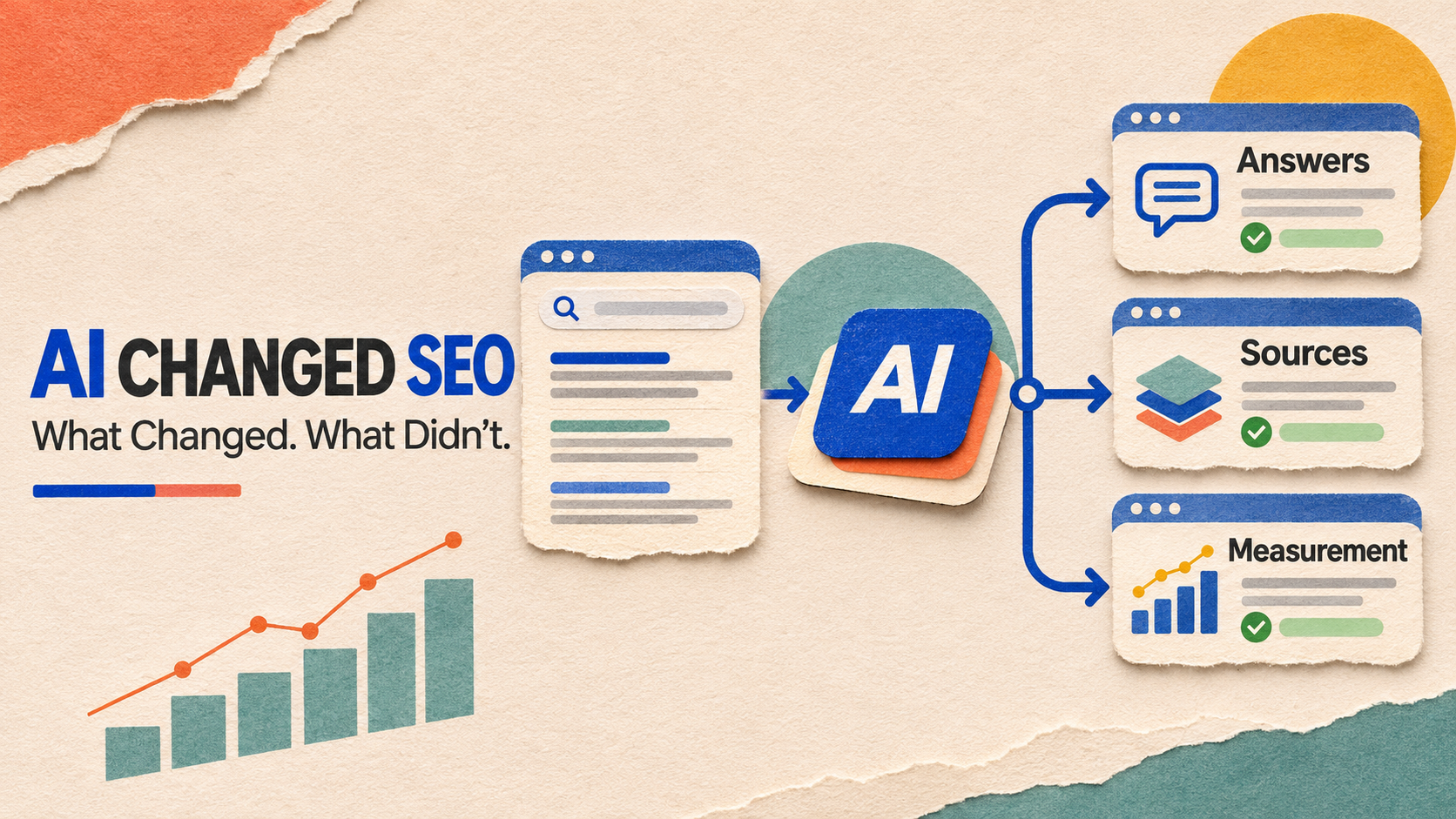
AI has changed SEO by turning search from a list of links into a system that can synthesize answers, explore several related queries, and recommend sources inside the response. It has also made content production dramatically cheaper. As a result, the scarce advantages are no longer writing speed or keyword coverage. They are original evidence, technical accessibility, recognizable expertise, clear structure, and the ability to measure visibility across more than one search experience.
What AI has not changed is just as important. Search engines still need to discover, crawl, index, and understand a page. People still need a reason to trust it. A ranking or citation still has little business value if the visitor does not take a useful next step.
The practical answer: AI did not replace SEO. It expanded the search surface, raised the cost of being generic, and moved the bottleneck from producing content to proving that the content deserves attention.
1. Search is becoming an answer-and-source interface
Traditional search results encouraged a familiar behavior: enter a query, scan a page of links, and choose a result. AI Overviews and AI Mode can instead assemble an answer from retrieved web pages while placing supporting links inside or around that answer.
This changes the role of a search result. A page may now contribute a useful fact, example, image, or perspective before the user visits it. The opportunity is not limited to holding one blue-link position. A site can become a supporting source for one part of a broader response.
That does not mean links have disappeared. Google has continued to add inline links, source context, article carousels, and other paths from AI responses to the web. The design keeps evolving, so SEO teams should avoid building a strategy around one temporary interface.
The durable goal is to publish material that an answer system can retrieve and that a person would still want to open: a first-hand test, a clear process, original data, an expert judgment, a useful tool, or a deeper explanation.
2. One query can trigger many searches
AI search can use query fan-out: the system generates several related searches to investigate different parts of a question. A broad request about improving a slow ecommerce site might lead to searches about image formats, server latency, Core Web Vitals, JavaScript execution, platform-specific fixes, and measurement.
This weakens a narrow keyword-only model. Matching one phrase is less useful than covering a real problem with enough depth, evidence, and context to support several related information needs.
The response should not be hundreds of thin pages created for every imagined fan-out query. Google explicitly warns against producing many pages primarily to manipulate rankings or generative answers. A stronger approach is to build a coherent topic system:
- A clear primary page that solves the main problem.
- Supporting pages for genuinely distinct sub-problems.
- Descriptive internal links that connect the evidence.
- Consistent entities, terminology, authorship, and claims.
- Updates when facts, products, or processes materially change.
AI has therefore made topical relationships more visible, but it has not made indiscriminate topic expansion a good strategy.
3. Generic content has lost economic value
Generative tools can produce a readable definition, list, summary, or comparison in seconds. When thousands of publishers can create the same article from the same public inputs, the output becomes a commodity.
Google’s guidance for generative AI search emphasizes unique, valuable, non-commodity content. The useful distinction is not whether AI touched the draft. It is whether the finished page contributes something that was not already available everywhere else.
Examples of defensible value include:
- Results from a test you actually ran.
- Screenshots or measurements from a real implementation.
- A decision framework shaped by practical constraints.
- Customer questions and objections observed first-hand.
- A dataset, calculator, template, or repeatable workflow.
- An expert interpretation that explains trade-offs, not just facts.
AI can help organize research and improve a draft. It cannot manufacture genuine experience, verified results, or accountable judgment. When AI reduces the cost of average content, those human inputs become more valuable.
4. Optimization now includes retrieval and citation readiness
Classic on-page SEO often focused on the page title, headings, keyword targeting, links, and technical signals. Those elements still matter, but AI-generated search adds another practical question: can a system identify the specific claim, understand its context, and connect it to a trustworthy source?
Citation-ready writing is not a special machine language. It is good explanatory writing:
- Answer the main question early.
- Use headings that describe meaningful sub-questions.
- Keep claims close to their evidence and attribution.
- Define important entities and terms consistently.
- Use tables only when they clarify a real comparison.
- Distinguish observation, inference, recommendation, and fact.
- Link to the primary source for changeable claims.
This helps readers as much as retrieval systems. Google says sites do not need special AI markup, artificial content “chunking,” or new text files to appear in its generative features. Pages still need to be indexed and eligible to appear with a snippet.
For a technical foundation, see AI Crawler Access: The Technical GEO Checklist Most Sites Miss.
5. SEO measurement is expanding beyond clicks
For years, SEO reporting centered on rankings, impressions, clicks, organic sessions, and conversions. AI answers create more cases where a brand or source can be visible without receiving an immediate visit.
That makes a single traffic number insufficient. Google introduced dedicated generative AI performance reporting in Search Console in 2026, providing a view of visibility in AI features alongside overall Search performance. The available reporting will continue to change, and other platforms expose different levels of data.
A practical measurement model separates four layers:
- Eligibility: important pages are crawlable, indexed, canonical, and able to appear with snippets.
- Visibility: impressions, rankings, AI-feature exposure, citations, and branded discovery.
- Engagement: qualified clicks, landing-page behavior, repeat visits, and assisted journeys.
- Business outcomes: leads, sales, subscriptions, product use, or another meaningful action.
No third-party visibility score should be presented as Google’s internal ranking data. Use platform data where it exists, document the limitations, and connect visibility to outcomes that matter.
For a fuller framework, read Zero-Click Search in the AI Era: What SEO Should Measure Beyond Traffic.
6. The SEO workflow is becoming more operational
AI can now accelerate keyword grouping, content inventories, log summaries, technical triage, internal-link suggestions, schema drafts, code changes, and publishing checks. The advantage comes from connecting these tasks into a controlled system, not from asking a chatbot for a longer checklist.
A reliable workflow has distinct stages:
- Collect evidence from Search Console, analytics, crawls, the website, and primary sources.
- Diagnose the problem and state uncertainty.
- Prepare a focused content or technical change.
- Review facts, risk, brand voice, and expected impact.
- Publish through a controlled approval step.
- Verify the live page, metadata, links, schema, image, and mobile layout.
- Measure the result over an appropriate period.
This is where protocols and agent tools become useful. SEO with MCP: From Analysis to Controlled Execution shows how read-only data access, draft tools, publishing permissions, and post-release validation can remain separate.
What AI has not changed about SEO
Discovery and indexability still come first
A page cannot contribute to Google’s generative search features if Google cannot access and index it. Robots directives, canonicalization, internal links, rendering, status codes, and sitemap hygiene remain operational basics.
Trust cannot be automated into existence
A confident paragraph is not evidence. Clear authorship, accurate claims, source attribution, transparent methods, corrections, and real experience continue to matter. This is especially important when advice could affect a person’s health, finances, safety, or major decisions.
User satisfaction remains the test
A page can be technically optimized and still disappoint the visitor. It must load well, work on mobile, answer the question, avoid intrusive distractions, and make the next step clear.
Business relevance matters more than output
Publishing more pages is not the same as creating more demand or value. The useful question is not “How much content did AI produce?” It is “Did the work improve qualified discovery, understanding, trust, or conversion?”
A practical AI-era SEO plan
For most websites, the following order is more useful than chasing a new acronym:
- Protect the foundation. Monitor crawling, indexation, canonical URLs, rendering, performance, structured data, and mobile usability.
- Map real audience problems. Combine search data with customer conversations, support questions, product knowledge, and sales feedback.
- Remove commodity pages. Consolidate repetition and improve pages that lack a distinct reason to exist.
- Add evidence. Publish tests, examples, screenshots, methods, data, expert commentary, and limitations.
- Structure for understanding. Use clear answers, descriptive headings, sensible internal links, and source attribution.
- Use AI for bounded work. Let it analyze, organize, compare, and draft while people own claims and publication.
- Measure the whole journey. Track eligibility, visibility, engagement, and business outcomes rather than clicks alone.
If you are building the operating process, AI for SEO: A Practical Workflow That Keeps Humans in Control provides a step-by-step model.
The strategic change
AI has made search more conversational, research more expansive, and content production easier. That increases the number of surfaces where a website can appear while making undifferentiated content easier to ignore.
The winning response is not to abandon SEO or rename every familiar practice. It is to make SEO more evidence-led. Build pages that machines can access and understand, give people a reason to trust and visit them, and use AI to improve the operating system behind the work.