
SEO with MCP: From Analysis to Controlled Execution
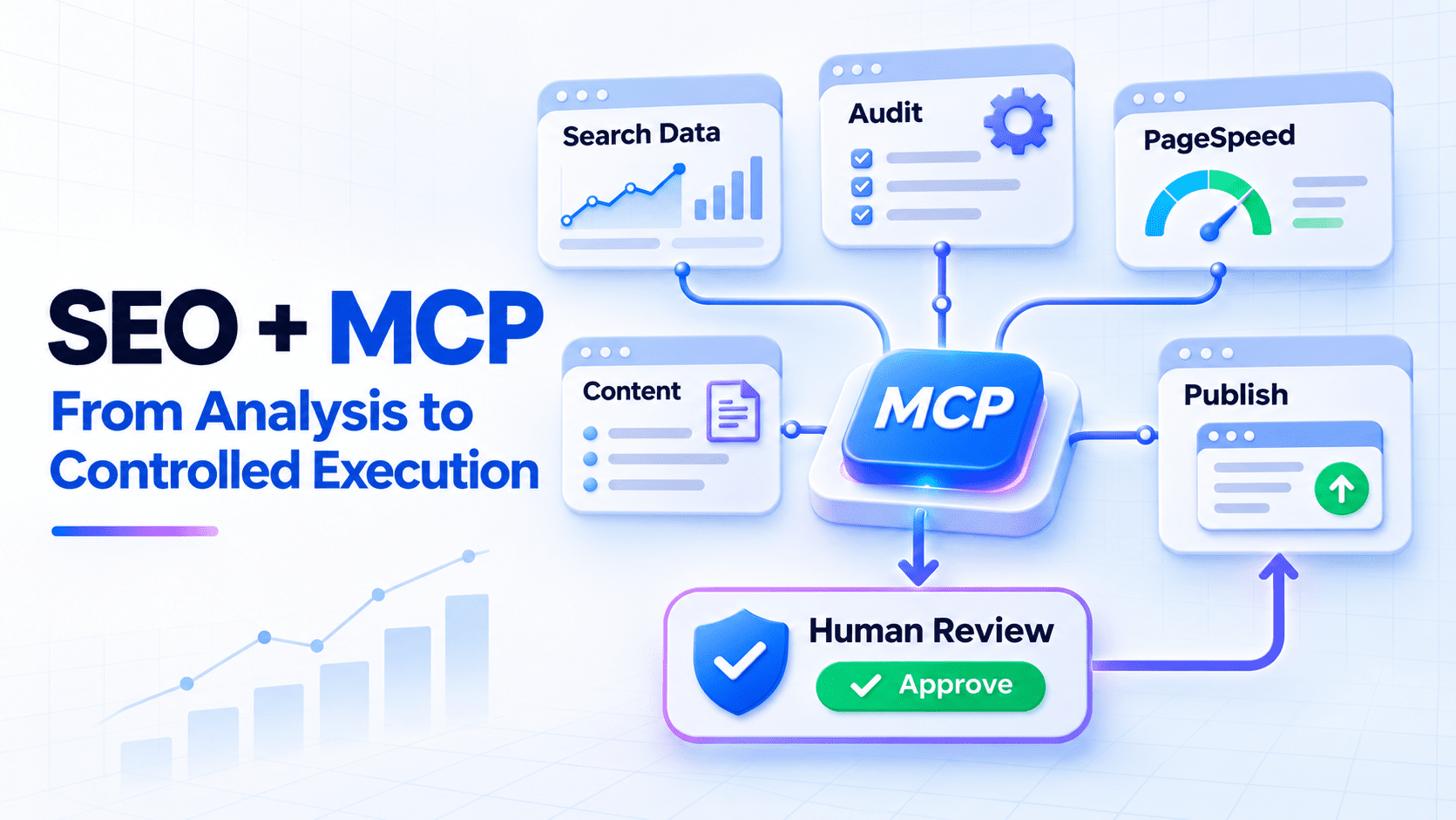
SEO combined with MCP turns an AI assistant from a recommendation engine into a controlled execution layer. Instead of copying data between Search Console, spreadsheets, crawlers, PageSpeed reports, content files, and a CMS, an AI agent can discover approved tools, retrieve structured evidence, propose actions, and execute selected changes.
The important word is controlled. MCP does not improve rankings by itself. It is a protocol for connecting AI applications to tools and data. The SEO value comes from the workflow built around those connections: accurate inputs, narrow permissions, review gates, reliable outputs, and measurable results.
The practical shift: without MCP, an AI may tell you what to do. With a well-designed MCP workflow, it can gather the evidence, prepare the change, request approval, apply the change, and verify the result.
What is MCP?
Model Context Protocol, or MCP, is an open protocol that lets AI applications connect to external capabilities through a consistent client-server architecture.
The official MCP documentation describes three core server primitives:
- Tools are executable functions, such as querying an API, updating a CMS entry, or running a crawl.
- Resources are contextual data sources, such as files, database records, API responses, or documentation.
- Prompts are reusable templates that structure how a task should be performed.
An MCP host is the AI application. It creates a client connection to each MCP server. The server exposes its capabilities, and the client can list and call the tools that the host permits.
This standardization matters for SEO because the work rarely happens in one platform. Search performance lives in Search Console. User behavior may be in analytics. performance data may come from PageSpeed Insights or CrUX. Content lives in a CMS or repository. Technical issues live in source code, hosting, and CDN configuration.
Why SEO needs an execution layer
Traditional SEO workflows contain many manual handoffs:
- Export search queries from Search Console.
- Filter the data in a spreadsheet.
- Check ranking pages and search intent.
- Run a technical or performance audit.
- Write recommendations in a document.
- Create tickets for developers or editors.
- Wait for changes to be deployed.
- Check the page again.
Every handoff adds delay and creates opportunities for missing context. An MCP workflow can keep the chain connected while preserving separate permissions for analysis and execution.
For example, an AI agent could use a read-only Search Console tool to identify pages losing clicks, a crawler tool to inspect titles and canonical tags, a PageSpeed tool to check performance, and a repository tool to prepare a patch. The final deployment can still require human approval.
A practical MCP architecture for SEO
| SEO function | MCP capability | Recommended permission |
|---|---|---|
| Search performance analysis | Search Console query tool | Read-only |
| Index status | URL Inspection tool | Read-only |
| Performance testing | PageSpeed or CrUX tool | Read-only |
| Site crawling | Crawler tool and crawl resources | Read-only, rate limited |
| Content inventory | CMS or database resources | Read-only by default |
| Draft production | File or CMS draft tool | Write drafts only |
| Code changes | Repository tool | Branch or pull request only |
| Publishing | CMS publish tool | Approval required |
| Post-release validation | HTTP, crawl, and structured-data tools | Read-only |
This separation prevents a common automation mistake: giving one agent broad production access simply because it also needs to read data.
Workflow 1: finding pages that need an update
The Search Console API provides programmatic access to Search Analytics, verified properties, sitemaps, and URL Inspection. An MCP server can wrap those APIs as narrow tools.
A useful workflow could run like this:
- Query pages whose clicks declined during a defined comparison period.
- Separate brand and non-brand queries.
- Check whether impressions, CTR, or average position changed.
- Retrieve the current page and its last modified date.
- Compare the queries with the page’s actual coverage.
- Prepare an update brief with evidence and proposed sections.
- Ask an editor to approve the brief before changing content.
The agent should not conclude that a decline was caused by an algorithm update without evidence. It should show the dates, dimensions, affected pages, and alternative explanations.
Workflow 2: technical SEO triage
An MCP-based technical audit can combine several sources without collapsing them into one unexplained score.
- A crawler finds broken links, redirect chains, missing canonicals, duplicate titles, and orphan pages.
- URL Inspection reports what Google knows about selected URLs.
- PageSpeed Insights returns Lighthouse diagnostics and performance data.
- The repository exposes the templates responsible for repeated issues.
- The hosting platform confirms whether the fix reached production.
The agent can then group issues by root cause. Ten pages with the same missing metadata field may be one template problem, not ten independent writing tasks.
This is where execution becomes valuable. The AI can prepare a focused code change, attach the affected URL list, run tests, and request approval. After deployment, it can crawl the sample pages again and report whether the expected fields changed.
Workflow 3: content production with evidence
MCP can also improve content operations, but it should not become a scaled-content machine.
A responsible content workflow starts with evidence:
- Retrieve first-party query and landing-page data.
- Review the existing content cluster to avoid duplication.
- Collect primary sources and current product documentation.
- Create a brief that defines user intent, unique value, internal links, and required evidence.
- Draft the article in a non-public state.
- Run factual, structural, and editorial checks.
- Require human approval before publication.
- Verify the live page, image, metadata, schema, and internal links.
The MCP server should expose separate tools for create_draft and publish_entry. Combining them into one unrestricted tool removes an important review boundary.
How tool design affects SEO quality
MCP tools use schemas that describe their inputs. Good tool design makes the intended action specific and auditable.
A weak tool might be called manage_seo and accept a block of free-form text. A stronger design uses small tools with explicit fields:
query_search_analytics(start_date, end_date, dimensions, filters)inspect_url(site_url, inspection_url)run_pagespeed(url, strategy, categories)create_content_draft(title, slug, content)publish_content(document_id)verify_live_page(url, expected_title, expected_image)
Narrow tools produce clearer logs, reduce accidental changes, and make approvals easier to understand.
Human approval is part of the architecture
The MCP specification recommends keeping a human in the loop for tool invocations. Applications can show available tools, display execution indicators, request confirmation, and keep activity logs.
For SEO, approval requirements should increase with impact:
- Low risk: read reports, crawl public pages, calculate comparisons.
- Medium risk: create briefs, save drafts, open pull requests.
- High risk: publish content, change robots.txt, modify redirects, submit or remove sitemaps, edit production templates.
Automating analysis does not require automating every action. The best system reduces repetitive work while preserving judgment at irreversible or high-impact steps.
Security requirements for SEO MCP servers
An MCP server may handle search data, analytics, CMS credentials, repository access, or customer information. Treat it as production infrastructure.
- Use least-privilege credentials and separate read from write access.
- Keep secrets outside prompts, logs, and tool results.
- Validate every tool input against its schema.
- Restrict which domains and properties a tool may access.
- Rate-limit crawls and external API calls.
- Require approval for publishing and production changes.
- Log the tool name, arguments, result, actor, and timestamp.
- Treat external pages, API responses, and retrieved files as untrusted data.
A page retrieved for SEO analysis can contain text that looks like an instruction. The agent should analyze that text as page content, not follow it as a command.
What MCP cannot do
MCP is useful infrastructure, but it does not create ranking guarantees.
- It cannot reveal Google’s private ranking systems.
- It cannot make weak content helpful through automation alone.
- It cannot prove causation from a traffic change.
- It cannot replace editorial experience or business judgment.
- It cannot make third-party SEO scores official Google metrics.
- It cannot safely execute broad production changes without permissions and review.
The protocol improves connectivity. The workflow determines whether that connectivity produces reliable SEO work.
A staged implementation plan
Stage 1: read-only analysis
Connect Search Console, PageSpeed, crawl data, and the content inventory. Produce reports with direct evidence and links to the source data.
Stage 2: draft creation
Allow the agent to create briefs, content drafts, and proposed code patches. Keep all output in reviewable states.
Stage 3: approved execution
Add narrow publishing and deployment tools with explicit confirmation. Define rollback procedures before enabling them.
Stage 4: verification and learning
After every approved action, verify the live result and record the outcome. Compare later Search Console and conversion data without claiming that one change caused every movement.
The real advantage is a closed loop
The most valuable SEO system is not the one that generates the most recommendations. It is the one that closes the loop:
observe → diagnose → propose → approve → execute → verify → measure.
MCP provides a standard way to connect the tools required for that loop. Search Console can supply first-party performance evidence. PageSpeed can supply diagnostics. Crawlers can inspect the live site. A CMS and repository can receive approved changes. Verification tools can confirm the result.
When those connections use narrow permissions and human review, MCP can make SEO faster without making it reckless. That is the useful combination: AI for reasoning, MCP for controlled access, and people for judgment.
Related reading
- AI Crawler Access: The Technical GEO Checklist Most Sites Miss
- AI for SEO: A Practical Workflow That Keeps Humans in Control
- Using AI for SEO and GEO: How Agent Skills Become a Website Growth System
- Zero-Click Search in the AI Era: What SEO Should Measure Beyond Traffic
Primary sources
- Model Context Protocol: Architecture overview
- Model Context Protocol: Understanding MCP servers
- Model Context Protocol specification: Tools
- Google Search Console API
- Google Search Console API reference
- Google PageSpeed Insights API
Editorial note: AI assisted with research organization and drafting. The article was reviewed against the linked primary documentation before publication.